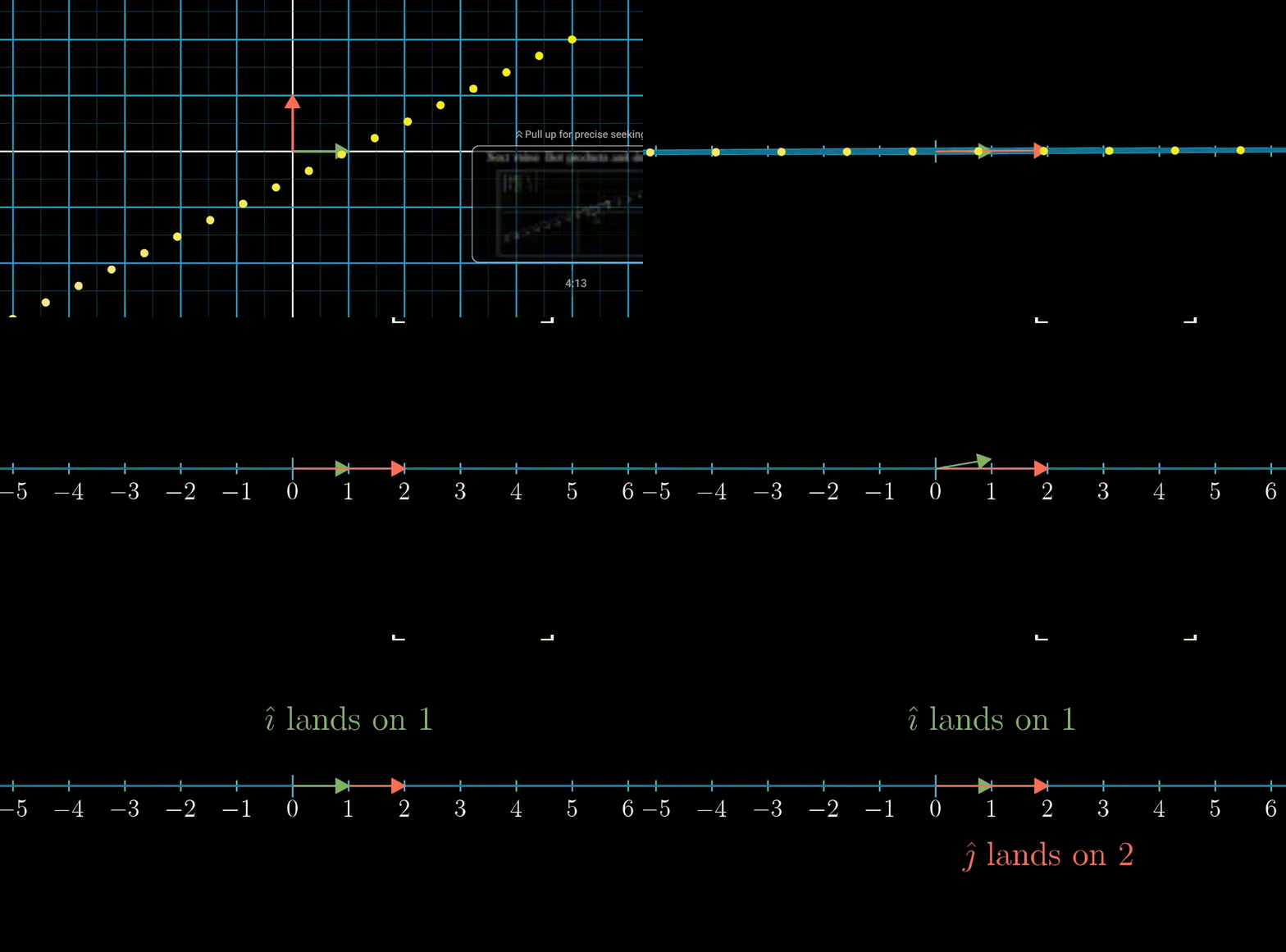
Here, we will discuss the intuition regarding thinking about Nonsquare matrices and transformations between dimensions.
Transformations between dimensions#
Think of a transformations which takes 2d vectors to 3d vectors:
Example 1:
$$ \underbrace{ \begin{bmatrix} 2 \\ 7 \end{bmatrix} }_{\text{2d input}} \rightarrow{L(\vec{v})} \rightarrow \overbrace{ \begin{bmatrix} 1 \\ 8 \\ 2 \end{bmatrix} }^{3d \ output} $$
Example 2:
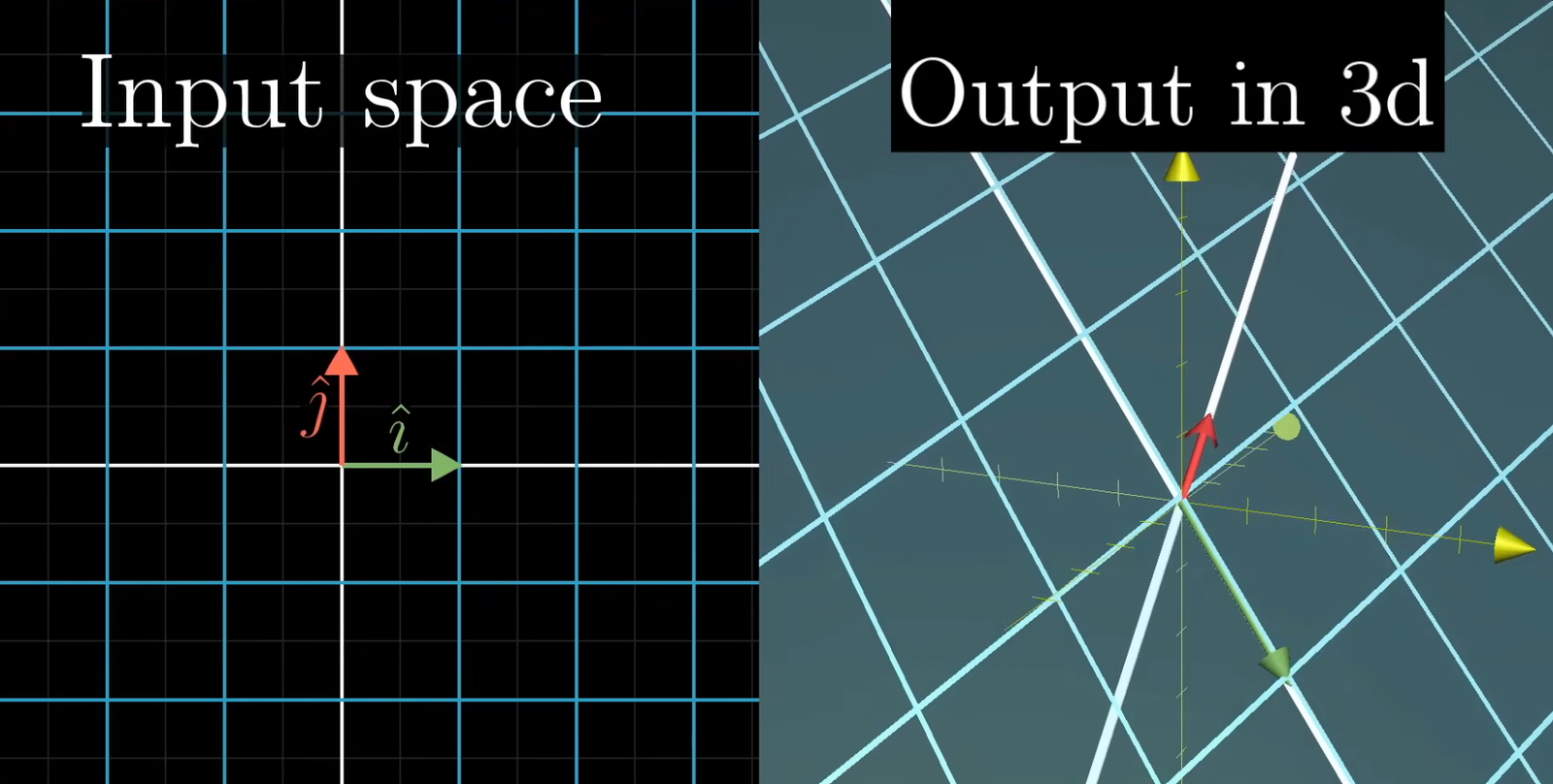
Here, the transformed matrix is:
$$ \begin{bmatrix} 2 & 0 \\ -1 & 1 \\ -2 & 1 \end{bmatrix} $$
A 3x2 matrix. The column space of this matrix is a 2d plane slicing through the origin of 3d space:

But, the matrix is still full rank. Since the number of dimensions in this column space is the same as the number of dimensions in the input space. So, if you see a 3x2 matrix, it means it maps 2 dimensions to 3 dimensions, because the 2 columns indicate that the input space has 2 basis vectors and the 3 rows indicate that the landing spots for each of those basis vectors is described with 3 coordinates.
Example 3:
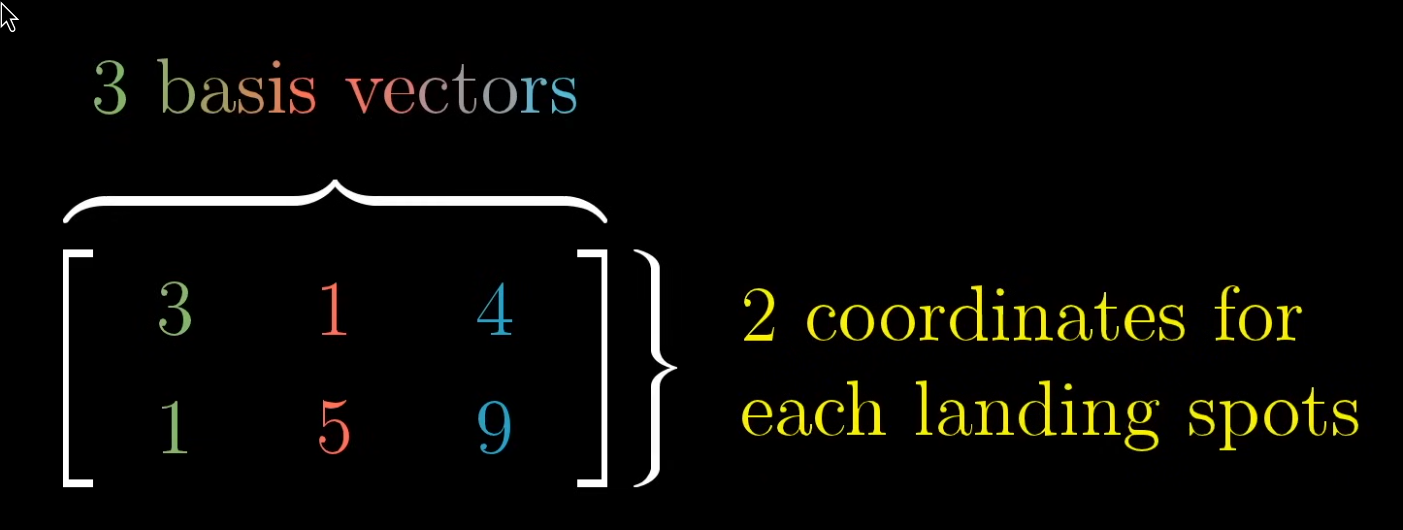
This is a transformation from 3d space onto the 2d plane:
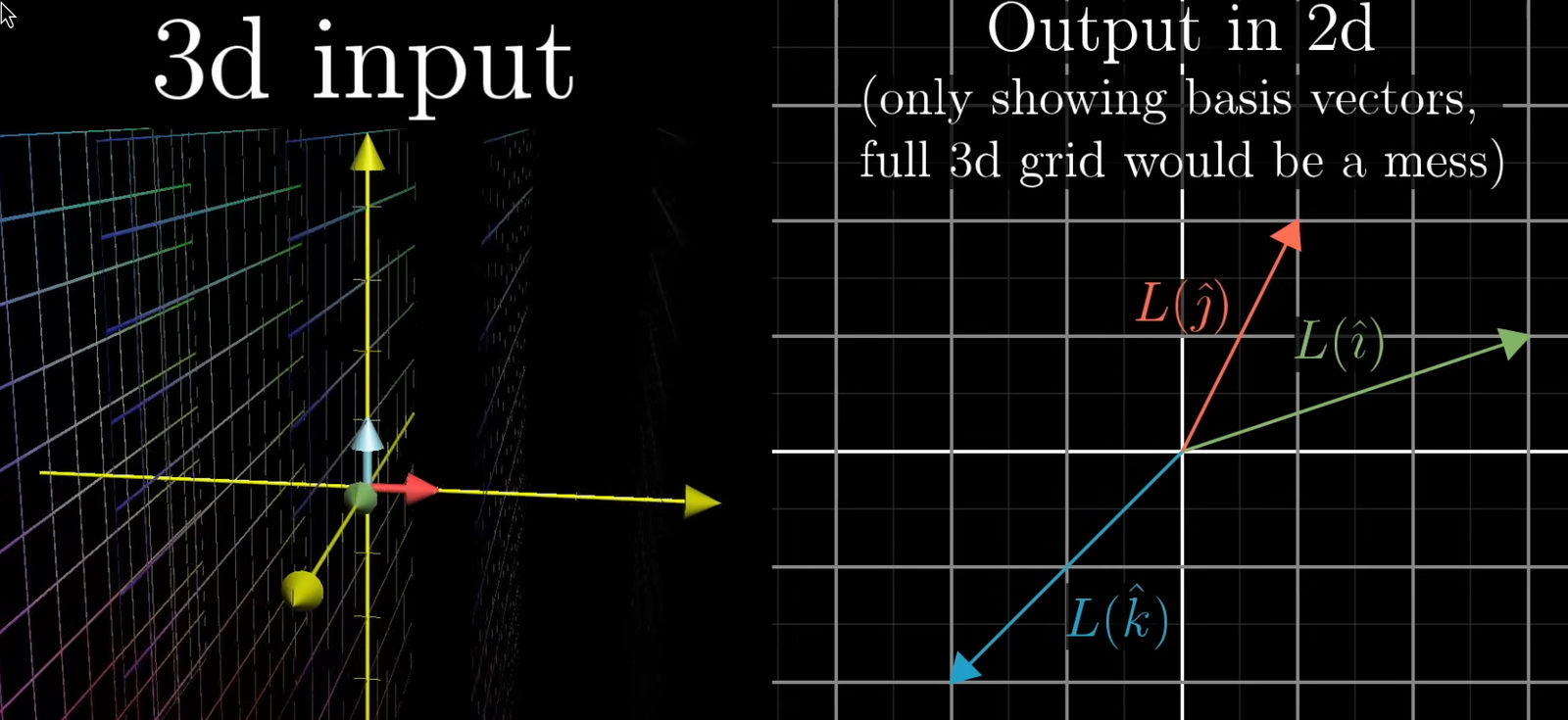
Example 4: From 2d to 1d transformation
$$ \underbrace{ \begin{bmatrix} 2 \\ 7 \end{bmatrix} }_{\text{2d input}} \rightarrow{L(\vec{v})} \rightarrow \overbrace{ \begin{bmatrix} 1.8 \end{bmatrix} }^{1d \ output} $$
This just transforms to a number line. So, transformations like this takes 2d vectors and spits out numbers.
These have to be linear transformations: So, grid lines remaining parallel and evenly spaced. Here is a way to visualize it for the transformation matrix \( \begin{bmatrix} 1 & 2 \end{bmatrix} \):